Jaber Khosravi Secretly Hanged for Hospital Shooting Despite Lacking Criminal Responsibility Due to Bipolar Episode
Iran Human Rights (IHRNGO); 12 October 2026: Jaber Khosravi, a man with a diagnosed and documented history of severe psychiatric illness, was executed in Damghan Prison. Sentenced to qisas (retribution-in-kind) for killing a police officer when a warning shot was inadvertently fired whilst disoriented during an acute psychotic episode, Jaber Khosravi was executed without prior notice, despite official medical records confirming diagnoses of bipolar disorder and recurrent psychosis, in an execution reported by state media only ten days later.
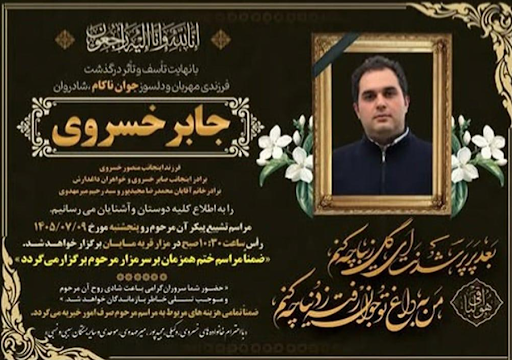
According to the judiciary’s Mizan News Agency, an unnamed man was hanged for the murder of a policeman in Damghan on an unspecified date. IHRNGO has established his identity as Jaber Khosravi, a 43-year-old Damghan native who was executed in Damghan Prison on 30 September 2026. He was sentenced to qisas (retribution-in-kind) by Branch 2 of the Semnan Province Criminal Court One for the murder of a policeman.
According to medical records obtained by IHRNGO, Jaber, who was arrested on 2 September 2022, was diagnosed with bipolar disorder, agitation, aggression and recurrent psychosis, and had been undergoing treatment for many years. A Damghan county Legal Medicine Office report dated 2 May 2023 also stated that he suffered from “panic attacks, generalised anxiety, mood disorder and depression, requiring emergency hospital admission as well as follow-up, therapeutic measures and medication.”
An informed source told IHRNGO: “Jaber Khosravi had a documented history of severe psychiatric illness. His medical history began at age 18, when he first sought psychiatric care without the knowledge of his parents. Throughout his adult life, he suffered from intense, chronic headaches and repeatedly attempted self-medication to manage his symptoms. He was eventually admitted to Aminabad (Razi) Psychiatric Hospital in Tehran, where he spent three months receiving specialised care and where medical professionals formally confirmed his condition. During his time behind bars, his family consistently purchased and delivered his required monthly psychiatric medications directly to prison authorities, who were fully aware of his medical state.”
Events of the Day in Question
Regarding the events that unfolded on 2 September 2022, the informed source said: “Four years prior to his execution, Jaber experienced a sudden, severe manic episode during the night, stripping completely naked and wandering into the streets. Although local residents brought him back, his family discovered the following morning that he had climbed onto the rooftop, stark naked and called emergency services. On the roof, emergency personnel poured three buckets of ice water over his head to revive him before bringing him down. During this initial removal, the ambulance driver struck Jaber, who screamed, asking if they had entered the house to kill him and his mother.
After the emergency teams temporarily withdrew, Jaber stripped naked once more and returned to the roof. The responders called the family to state that Jaber had struck their driver and that they would only return if accompanied by backup. Expecting two strong men to assist, the family instead found their home overwhelmed by numerous police officers, who again poured ice water over Jaber's head, brought him down and had emergency services transport him to Velayat Hospital in Damghan. At the hospital, staff failed to properly restrain him as a psychiatric patient and instead administered an incorrect injection that severely heightened his mania and disorientation. Trembling uncontrollably and stating that he wanted to go home, Jaber noticed a departmental police vehicle and pointed out to an officer that his 80-year-old retired father had served 30 years in the police force driving that very type of car, begging, ‘I beg of you, take me home.’
The officer mocked his plea with clicking sounds ("Tut! Tut! Tut!") to indicate refusal, after which officers grabbed Jaber from behind and forcibly squeezed his side. This physical assault directly targeted an unhealed surgical site where doctors had recently removed gallstones and glued his gall bladder to his liver, causing heavy bleeding that thoroughly soaked his clothes and shoes. As officers sprayed him with pepper spray, Jaber, terrified by the sight of his own blood and shaking violently, grabbed the officer's firearm. The officers threw Jaber to the ground, causing the weapon to fall; disoriented and oblivious to his actions, Jaber retrieved the gun and discharged a warning shot into the air, which inadvertently struck an officer. ”
According to the Mizan report, the officer died as a result of his injuries.
Arrest and Execution
Following his arrest, Jaber was taken to Police Station 12 in Damghan. The informed source stated: “Multiple medical specialists and psychiatric doctors evaluated him and provided official documentation attesting to his long-standing bipolar disorder and periodic psychosis. His family submitted official letters from doctors and prison records to judicial officials, including the prosecutor and investigator. Despite these submissions, authorities dismissed his psychiatric condition, alleging that he was faking his mental illness. During his four years in custody, Jaber was subjected to physical violence that resulted in broken teeth and bloodstained clothing. His physical health deteriorated significantly, leading to a 16-day hospitalisation at Semnan Kowsar Hospital. Although the victim's family initially showed willingness to grant forgiveness, senior police officials intervened directly to block the process.”
Despite ongoing appeals to judicial authorities, requests for a stay of execution were denied. Appeals made by his family to the prosecutor in Shahroud for additional time were also rejected. Jaber’s execution was carried out on the morning of 30 September, without prior notice to his family. The date of his execution has been verified through his death certificate.
“To protect his 80-year-old blind father, who suffers from severe heart conditions, his family was forced to hide the news of his execution, fearing that the shock would prove fatal,” the informed source told IHRNGO.
The State Narrative
The official state narrative regarding Jaber’s case undergoes a distinct evolution across state media outlets, systematically shifting focus from an emergency response involving a severely ill psychiatric patient to an intentional murder justifying capital punishment. On the day of Jaber’s arrest, IRNA frames the incident around a heroic police officer martyred while protecting hospital staff and citizens. Whilst acknowledging that Jaber was admitted as a psychiatric patient following a rooftop suicide attempt earlier that morning due to family problems, IRNA attributes the shooting to Jaber exploiting the officer's goodwill and trust to grab his firearm, claiming that he had a history of addiction. Iran Newspaper details the pre-trial investigative phase, noting that Jaber claimed no memory of the incident due to severe psychological distress, which led a criminal judge to order his one-week transfer to a psychiatric hospital in Tehran to evaluate his sanity and criminal responsibility. By the time of execution, Mizan News Agency, completely sanitises the narrative by omitting all references to Jaber's psychiatric history, alleged suicide attempt, medical transfer and mental health evaluations. Instead, Mizan presents a reduced judicial account of deliberate disarming and murder, asserting that following full legal proceedings and Supreme Court confirmation, Jaber was executed at the request of the victim's family.
Article 149 of Chapter Two of the Islamic Penal Code (IPC) which relates to the lack of criminal responsibility states: “If the perpetrator has a mental disorder at the time of committing the crime that they lack willpower or judgement, they are considered insane and are not criminally responsible.”
While obtaining documented evidence of medical diagnosis is difficult due to a lack of transparency, IHRNGO has reported many cases of people suffering from psychosocial and intellectual disabilities being executed throughout the years.
In carrying out such executions, the Islamic Republic of Iran is breaching both its own laws and its international obligations. A resolution adopted by the Office of the United Nations High Commissioner for Human Rights urged States “not to impose the death penalty on a person suffering from any form of mental disorder or to execute any such person.”
Those charged with the umbrella term of “intentional murder” are sentenced to qisas (retribution-in-kind) regardless of intent or circumstances due to a lack of grading in law. Once a defendant has been convicted, the victim’s family are required to choose between death as retribution, diya (blood money) or forgiveness.