Hassan Divband, Hamid Kazemi and Reza Zanganeh Hanged; At Least 39 January Protesters Executed
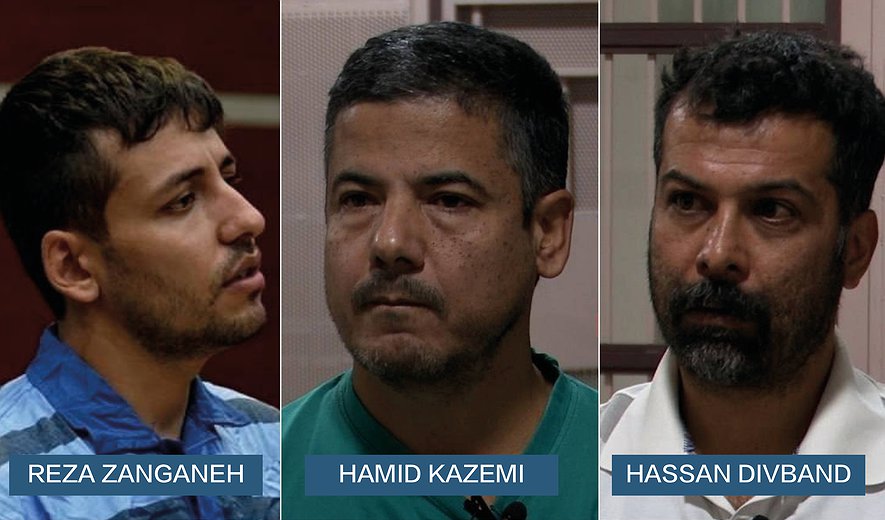
Iran Human Rights (IHRNGO); 8 November 2026: State media reported the execution of Hassan Divband, Hamid Kazemi and Reza Zanganeh, three protesters convicted of non-fatal offences in connection with the protests in Karaj on 8 and 9 January. Since 19 March, at least 39 protesters have been executed in connection to the December 2025–January 2026 protests, an average of more than one execution per week.
Condemning their execution in the strongest terms, IHRNGO once again urges the international community to raise the political cost of executions by prioritising the death penalty in their negotiations and meetings with the Islamic Republic.
Mahmood Amiry-Moghaddam, the director of the organisation stated: “Like others before them, Hassan Divband, Hamid Kazemi and Reza Zanganeh were deprived of their due process and fair trial rights. Hundreds more, including protesters and those arrested during the war, face the risk of being sentenced to death or having their death sentences carried out.
He added: “Unless the political cost of these executions increases, there is a serious risk that we will soon witness daily executions of protesters and political prisoners. Coordinated and sustained political pressure from the international community, particularly the European Union and governments maintaining diplomatic relations with the Islamic Republic is required to slow down the Islamic Republic’s execution machine.”
According to the judiciary’s Mizan News Agency, Hassan Divband, 30, Hamid Kazemi and Reza Zanganeh, 27, were hanged at an unspecified Karaj prison on 8 November 2026. They were arrested in connection to the 8 and 9 January protests and sentenced to death by the Karaj Revolutionary Court on charges of "participation in operational actions on behalf of the sinister Zionist regime, the United States and hostile groups under the Law Intensifying Punishments for Espionage and Cooperation with the Zionist Regime and Hostile States Against National Security and Interests." Their assets were also confiscated.
Hassan Divband, the first defendant in the case, was arrested on 11 January, per the official report. It is not clear when the second defendant, Hamid Kazemi, was arrested. According to unofficial reports, Reza Zanganeh, the third defendant in the case, was a 27-year-old car mechanic and had been arrested on 3 April.
The Mizan report alleges that Hassan Divband, Hamid Kazemi and Reza Zanganeh operated an armed cell in Karaj during the nationwide protests of 8 and 9 January. Hassan allegedly mobilised his workshop staff, Hamid manufactured Molotov cocktails and improvised grenades and Reza sabotaged an electrical substation to cause a blackout. Together with their other co-defendants, they were accused of stabbing two security officers, setting fire to bins, blocking streets and attacking public facilities at one location, and destroying CCTV and setting fire to a public building at another location.
Speaking to IHRNGO about Reza Zanganeh’s case, an informed source said: “In the issued judgment, it expressly stated verbatim that when Mr Reza Zanganeh reached the electrical breaker box, he was carrying wire cutters; however, upon seeing the power switch, he disconnected the electricity by pressing it, meaning there was no longer any need to use the cutters or sever the wires and cables. The aforementioned judgment explicitly notes that no acts of destruction were carried out against the electrical cables. Consequently, no destruction of public property fundamentally took place that could justify classifying the attributed conduct as the destruction of public property or an act of sabotage on behalf of a hostile state under Article 1 of the Law Intensifying Punishments for Espionage. In other words, what actually occurred was merely cutting the power by pressing a switch rather than destroying equipment or electrical wiring.”
Although the Islamic Republic claims to have relied on “confessions, documentary evidence and CCTV footage” to identify and convict the protesters, none of them are identifiable in the propaganda video published by state media. In the video, the protesters’ coerced confessions and testimonies against each other are the only evidence presented.
According to the Follow-up Committee on the Status of Detainees, four of Hassan’s relatives were also arrested in Karaj between 10 and 18 January: 29-year-old Ali Asghar Divband was detained at his workplace on 10 January; 15-year-old Ali Akbar Divband was taken into custody from the family home on 11 January; and one week later, on 18 January, Mohammad Ali Divband (50) and another relative, Hamidreza Forouhar (20), were both arrested at their workplaces.
The remaining eight defendants in the case were sentenced to prison terms ranging from five to ten years.
At least 39 protesters have been executed in connection to the December 2025–January 2026 protests since 19 March, listed here in order of execution: Saleh Mohammadi, Saeed Davodi, Mehdi Ghasemi, Amirhossein Hatami, Mohammad Amin Biglari, Shahin Vahedparast Kolor, Ali Fahim, Amir Ali Mir Jafari, Erfan Kiani, Sasan Azadvar, Ebrahim Dolatabadnejad, Mehdi Rasouli, Mohammadreza Miri, Mohammad Abbasi, Abbas Akbari Feizabadi, Ashkan Maleki, Mehrdad Mohammadinia, Fathollah Avari, Javad Zamani, Abolfazl Saedi, Mohammad Amini Dehaghani, Erfan Esfandiari, Gol Mohammad Mohammadi, Mehdi Khanaki, Abolfazl Sepahi Badjani, Amirhossein Safari Hosseinabadi, Shahram Sadeghi, Ghaem Hosseini, Majid Adineh, Majid Nikandish, Ali Hemati-Sistani, Siavash Jamshidi-Kheirabadi, Alireza Raisi Badjani, Alireza Raisi Hassan Hendouyi, Amirhossein Maleki, Amirhossein Ebrahimi-Pazveh, Hassan Divband, Hamid Kazemi and Reza Zanganeh.
Mehrab Abdollahzadeh and Aref Khoshkar, two “Woman, Life, Freedom” protesters, were also executed during this period.
More from @ihrights
IHRNGO is building a strong civil society, through empowerment of the citizens, promoting and defending the human rights.
Latest Cartoon
Latest Report