Chiyako: Equality must not require us to become alike
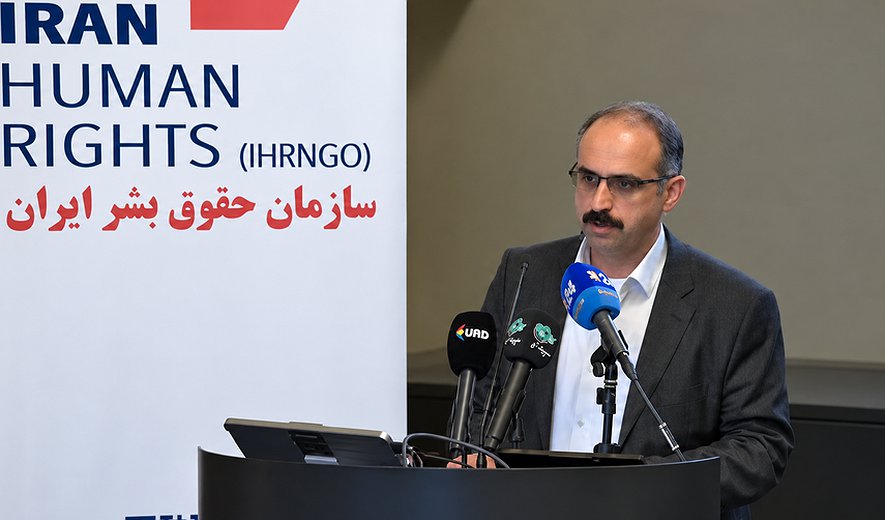
The representative of the Kurdistan Free Life Party (PJAK) told the Oslo conference “Iran’s Human Rights Crisis: From Shared Principles to Joint Action” that individual and collective rights must be guaranteed. “A democratic society must not ask people to become alike in order to be equal,” he said. “Human rights must govern not only the conduct of a future government, but our own political conduct today.”
According to Iran Human Rights (IHRNGO), Ehwen Chiyako argued that legal equality was essential but insufficient. It must be accompanied by recognition of collective identities and rights, meaningful participation by different communities and attention to their differing experiences of repression. He also called for work on transitional justice to begin now and for political opponents’ rights to be defended without discrimination.
The conference, held in Oslo on 25–26 September 2026, brought together representatives of political parties and organisations. Organised and hosted by IHRNGO, it was the sixth event in its “Iran and the Transition from Authoritarianism” series.
Citing executions, arbitrary detention, torture, the suppression of protests and discrimination, Chiyako said: “Human rights cannot be treated as a secondary concern or postponed until after political change.” Yet neither the intensity nor the form of abuses was uniform across Iran.
In Kurdistan, Balochistan and other marginalised communities, political repression intersected with discrimination based on nationality, language, religion, economic circumstances and geography. “Recognising these differences does not mean ranking suffering or setting victims against one another. It is a condition for seeing the full picture of human rights violations in Iran.”
Chiyako asked whether human rights should serve merely as common ground for opposing the present system, or also as a basis for rethinking the society that would follow it. Moving beyond the Islamic Republic required more than replacing its rulers. It meant changing the relationships that allowed people and communities to be excluded from politics and decision-making.
“For a society such as Iran, formal equality between citizens is not enough.” Iran comprised national and linguistic communities, followers of different religions and social groups with distinct historical experiences of central power.
He distinguished equality from enforced uniformity. Equal rights must not depend on concealing differences or confining them to private life. “We advocate free and pluralistic citizenship: citizenship that guarantees individual rights unconditionally without excluding collective identities and rights from public life.”
Democratic unity, he argued, rested on recognising differences and establishing common rules for coexistence. “A shared life is not built by eliminating differences.” He criticised a tendency within parts of Iranian political thought to define the country according to an idealised vision rather than its diverse social reality.
Democracy therefore involved more than elections and transfers of power. It also required power to be distributed throughout society, with women, different communities, civic organisations, trade unions and local institutions participating meaningfully in decisions.
Turning to transitional justice, Chiyako said: “This process begins today, through independent documentation, the preservation of evidence and victims’ memories, and listening to different accounts.” Truth-seeking, accountability, reparations and reform of institutions implicated in repression must form part of the future democratic order.
“Transitional justice must not become another cycle of revenge. Nor can truth and accountability be sacrificed in the name of national reconciliation.” Justice needed to address both individual responsibility and the structures that produced discrimination and inequality, with guarantees of non-recurrence as its goal.
Defending others’ rights offered a basis for cooperation across political divides. “No majority can put the fundamental rights and dignity of a social group or minority to a vote.”
“If we defend only those who think like us, we are not yet defending human rights. We are defending our own group.”
Chiyako identified several areas for joint action: independent, coordinated documentation; defending victims without discrimination; greater attention to regions facing severe and overlapping forms of repression; opposing executions and torture; securing fair trials; and supporting civil society.
Political groups themselves also needed mechanisms to hold them accountable. Above all, cooperation required those affected to have a voice. “Victims and representatives of different communities must not merely be subjects of discussion. They must themselves participate in dialogue, decision-making and defining solutions.”
Translated from Farsi via machine translation and lightly edited for clarity.
More from @ihrights
IHRNGO is building a strong civil society, through empowerment of the citizens, promoting and defending the human rights.
Latest Cartoon
Latest Report